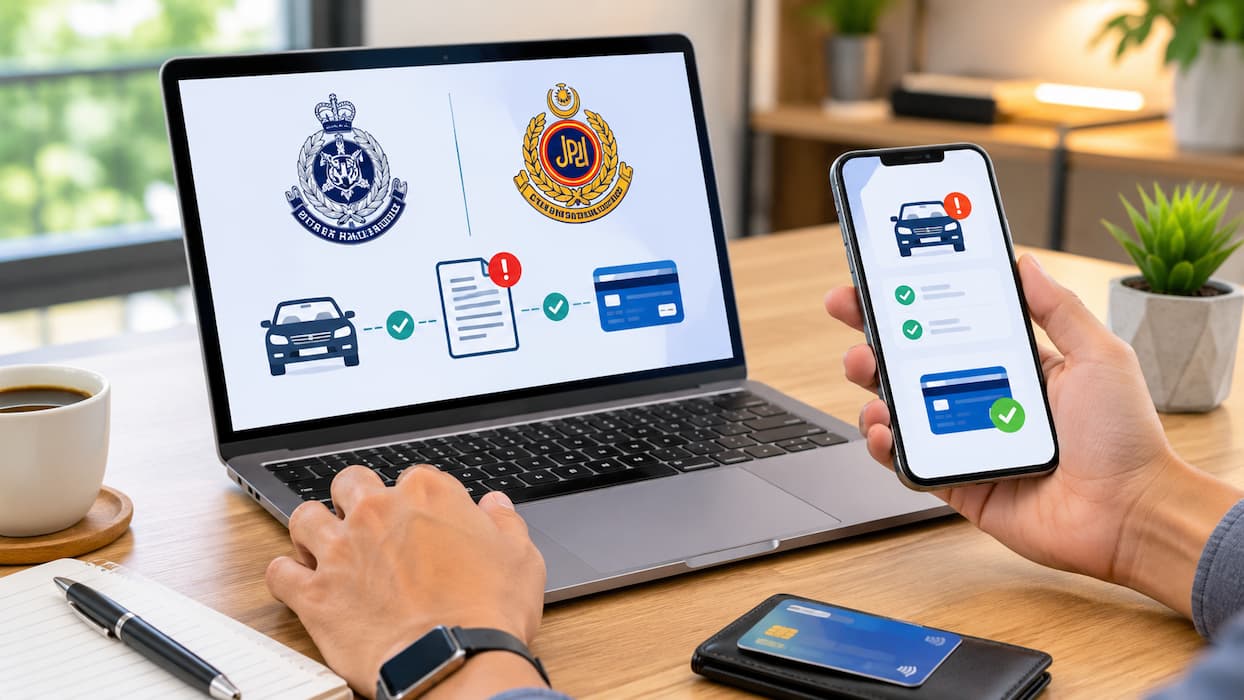
When you get a traffic summons in the mail, it might be confusing to figure out who issued it and how to pay it online rather than at a counter. For the majority of summonses, drivers in Malaysia no longer need to visit a police station or JPJ office, contrary to what many drivers believe. These days, official government platforms and several authorized payment channels make it easy to read basic offense details, check outstanding traffic penalties, and pay them online.
It is natural to have questions if you are unfamiliar with dealing with summonses. Please explain the distinction between a JPJ summons and a PDRM. Will it take some time for you to process the payment? Can I expect an immediate update when I pay online? In addition to providing answers, this guide explains the process in plain English, so newcomers won’t get confused by technical jargon. These processes are derived from the ones now offered by the Road Transport Department (JPJ), the Royal Malaysian Police (PDRM), and Malaysia’s MyGovernment website.
First, Understand Whether Your Summons Is From PDRM or JPJ
Before you start searching online, it’s important to know which agency issued your summons because each authority manages its own records and online services.
A PDRM summons is issued by the Royal Malaysia Police and usually relates to offenses such as speeding, running a red light, illegal parking in certain circumstances, or other violations enforced by the police.
A JPJ summons, on the other hand, is issued by the Road Transport Department and often involves vehicle licensing, road tax, driving license matters, technical vehicle offenses, overload violations, or breaches of road transport regulations. Although both are traffic-related, they are processed through different systems.
Understanding the issuing authority helps you choose the correct portal from the beginning instead of wondering why your summons cannot be found on another website.
| Agency | Common Types of Offences | Official Online Service |
|---|---|---|
| PDRM | Speeding, traffic signal offences, police-issued traffic summonses | MyBayar PDRM |
| JPJ | License, road tax, vehicle and transport regulation offences | MyJPJ / MySIKAP |
What You’ll Need Before Checking Your Summons
Checking your summons online only takes a few minutes, but preparing a few details beforehand makes the process much smoother. Fortunately, you don’t need a large number of documents or paperwork. Most official platforms identify your records using your MyKad number or vehicle registration number. If you’re checking a summons issued to another person, remember that access may be restricted for privacy and security reasons.
Before opening any website or mobile application, please ensure you have:
- Your MyKad or identification number
- Vehicle registration number (if applicable)
- Stable internet connection
- An account on the relevant government platform if required
- Online payment method in case you decide to pay immediately
Having these details ready allows you to move from checking the summons to completing payment without interrupting the session.
How to Check PDRM Traffic Summonses Online
If your summons was issued by the Royal Malaysia Police, the easiest way to check it is through the official MyBayar PDRM platform. First-time users need to register an account before they can view outstanding summonses. After signing in, the dashboard displays available police summons records associated with your identification number. Each entry usually includes the offense reference, date, and payment status, allowing you to review the information before making any payment.
Take a few moments to confirm that the summons belongs to you and review the offense details carefully. If something appears incorrect or you believe the summons was issued in error, avoid paying immediately until you’ve clarified the matter through the appropriate PDRM channel. Once payment has been completed, resolving disputes may become more complicated. (rmp.gov.my)
Checking JPJ Summonses Through MyJPJ
Drivers who receive summonses issued by the Road Transport Department can check them using the official MyJPJ mobile application or other approved JPJ online services.
Unlike older systems that required frequent counter visits, MyJPJ allows eligible users to view various vehicle and licensing records directly from their smartphone. After signing in, navigate to the summons section to view the available records linked to your account.
If you’ve recently received a summons, don’t be concerned if it doesn’t appear immediately. Depending on processing times, there may be a short delay before new records become visible across all online systems. Waiting a short while before checking again is often sufficient if the notice was only recently issued. (jpj.gov.my)
Paying Your Traffic Summons Online
Once you’ve confirmed the summons details, paying online is usually straightforward. The exact payment options depend on the platform you’re using, but most official services support common electronic payment methods. Please take a moment to review the amount carefully on the payment page to ensure you are paying the correct summons. This is especially important if your account has multiple offenses listed.
The typical payment process follows this sequence:
| Step | What Happens |
|---|---|
| Review the summons. | Confirm offence details and outstanding amount |
| Select payment | Choose the summons you want to pay |
| Complete payment | Use an available electronic payment method |
| Receive confirmation | Save or download the payment receipt |
| Status update | Wait for the system to reflect successful payment |
Avoid refreshing the payment page while your bank is processing the transaction. If the confirmation page takes longer than expected to load, first check your banking application before attempting another payment to prevent duplicate transactions.
How Long Does It Take for the Payment to Update?
Many motorists expect their summons to disappear immediately after making payment. In reality, different government systems may take some time to synchronize their records. Although payment confirmation is often available quickly, the summons status may not change instantly across every portal. Processing times vary depending on the payment channel and the agency responsible for the summons.
If your receipt clearly shows that payment was successful, keep a copy and allow reasonable time for the status to update before assuming that something has gone wrong. Should the record remain unpaid after an extended period, your payment receipt will be important when contacting customer support.
Be Careful During Nationwide Summons Discount Campaigns
Several times each year, government agencies announce special traffic summons discount campaigns during public events or national programs. These campaigns often allow eligible motorists to settle selected summonses at reduced rates for a limited period.
Because these promotions attract significant public interest, unofficial websites and misleading social media posts sometimes appear alongside genuine announcements. Instead of relying on forwarded messages or screenshots, always verify whether a discount campaign has been officially announced through PDRM, JPJ, or the Malaysian Government before making payment.
Waiting for a legitimate discount may save money, but delaying payment without confirming your eligibility could also result in missing the promotional period altogether.
Common Reasons You May Not Find Your Summons
If your search returns no results, it doesn’t always mean the system has failed. Several perfectly normal situations can explain why a summons isn’t appearing yet.
| Situation | Possible Explanation |
|---|---|
| Recently issued summons | Still being processed |
| Wrong identification number entered | No matching record found |
| Wrong platform used | PDRM and JPJ records are separate |
| Summons already settled | Outstanding balance no longer exists |
| Temporary maintenance | Government service temporarily unavailable |
Checking these possibilities first often saves unnecessary worry and prevents repeated unsuccessful searches.
Tips for Managing Traffic Summonses More Efficiently
Instead of waiting until several fines accumulate, make it a habit to check your record periodically. This is especially useful if multiple family members drive the same vehicle or if you travel frequently for work.
A few simple practices can help:
- Keep digital copies of all payment receipts.
- Use only official government platforms or authorized payment partners.
- Verify the offense details before completing payment.
- Don’t ignore notification emails or SMS messages from official sources.
- Check for official discount announcements before paying, but don’t rely on unverified social media posts.
These habits make future renewals of your driver’s license or vehicle-related transactions much smoother because you’ll know your record is already up-to-date.
FAQs
1. Does a website exist where I may view summonses from both the PDRM and JPJ?
On occasion, yes. MyBayar PDRM is the main portal for checking PDRM summonses, while MyJPJ and other authorized JPJ services are the best places to get JPJ summonses. Although several government entities handle the records, some government portals offer links to various services.
2. To view my summons, is it necessary to register?
Under the majority of official circumstances, yes. If you want to make sure that no unauthorized parties may access the summons records linked to your identity, creating an account is a sensible first step.
3. Does paying traffic tickets online pose any security risks?
Absolutely, but only if you transact through official government platforms or reputable payment processors. Be wary of clicking on links or visiting unexpected websites while making a payment.
4. Will my summons vanish the moment I pay?
That is not always the case. Although confirmation of payment is usually accessible fast, there may be some extra processing time before the summons status changes due to system updates between agencies.
5. Is it possible for someone else to look over my summons?
Access to summons information is often restricted to the account holder or an authorized individual using the relevant identifying details due to the sensitive data it includes.
6. When I fail to pay my traffic ticket, what will happen?
Depending on the nature of the offense and the rules in effect, there may be further administrative or legal ramifications for disregarding a summons. We recommend that you review the notice as soon as possible and pay any eligible summonses within the specified timeframe. The details might differ based on the authority that is issuing the document and the type of offense committed.
Conclusion
A few short years ago, it was a major hassle to verify and pay traffic summonses online. Whether your summons was issued by PDRM or JPJ, you may access your records, make safe payments, and maintain digital proof of the transaction through the official online platforms. No need to visit a service counter.
The first and foremost thing new users need to do before selecting the appropriate site is to determine whose agency issued the summons. You can confidently manage traffic summonses by using official websites, carefully studying the offense facts, saving every payment receipt, and checking your records periodically. This will help you prevent unnecessary delays or confusion in future vehicle and license concerns.