
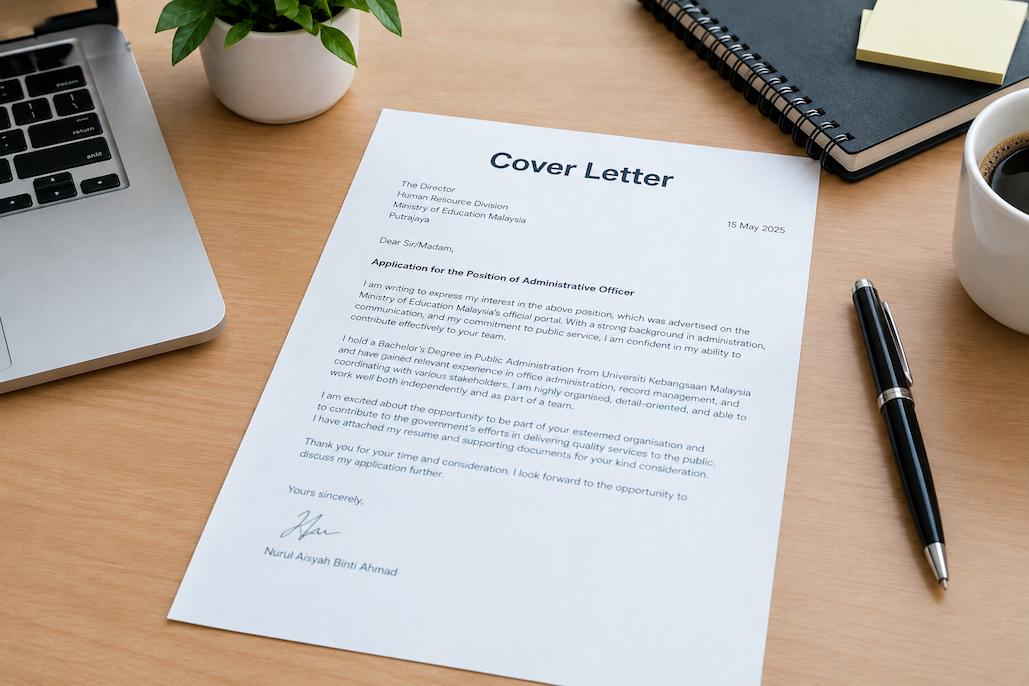
How to Write a Cover Letter for Public Sector Applications

Working in the Malaysian public sector differs from working in the private sector. The government recruitment process is more structured and assesses applicants based on their qualifications, skills, and service standards. Although not all government positions require a cover letter, a well-written letter can effectively showcase your professional experience.

It is a common mistake to treat a cover letter for a government position like a regular job application email. Copying templates, modifying job descriptions, and sending the same content to different departments is unlikely to make a lasting impression. A strong cover letter must clearly demonstrate how your qualifications align with the position, your relevant experience, and why you wish to serve the public sector. The letter should reinforce your application experience and not simply be a repetition of your personal statement.

Avoid exaggeration when applying for positions at Malaysian government agencies. Present yourself as credible, well-prepared, and competent for the position. A concise cover letter that links your experience to the job requirements is generally more valuable than a long and exaggerated statement.

Determine Ia Cover Letter is Needed

Before writing your cover letter, first review the job requirements. This step may seem obvious, but many applicants spend considerable time preparing material that is not specifically requested by the employer. Government recruitment utilizes various channels and processes. SPA9 publishes some vacancies, while others are handled by ministries, departments, statutory bodies, municipalities, and other public organizations. Application criteria may differ by agency.

If a cover letter is required, ensure that you follow the instructions. Do not assume that uploading irrelevant documents will increase your chances of success. In a highly structured recruitment process, correctly following instructions is more important than submitting additional material. Before writing your cover letter, please review the following information:

  • Specific job title.
  • Agency or department.
  • Application method.
  • Is a cover letter required?
  • Format or word limit.
  • Relevant department or recipient.

Required documents for the application. Meeting the application requirements is the first step toward a strong cover letter.

What’s Different About Public Sector Cover Letters?

Cover letters in the private sector typically emphasize personal achievements, sales results, income, or ambitions. These achievements are also important for government applications, but the emphasis may differ. Employers in the public sector want to know if you are competent, adhere to rules and regulations, are responsible, communicate effectively, and can contribute to the company’s success. Integrity, professionalism, social responsibility, teamwork, and a service-oriented attitude can be crucial, depending on the specific position.

However, this does not mean that your cover letter should sound formal or bureaucratic. Government applications need to have a human touch. The best approach is to demonstrate professionalism concisely and clearly.

Weak Approach Stronger Approach
“I am applying because I desperately need a job.” Explain your interest in the role and relevant qualifications.
“I can do everything required.” Demonstrate specific skills with relevant examples.
“I am hardworking and passionate.” Show how your experience demonstrates reliability and commitment.
“Please consider me because I am the best.” Please explain how your background aligns with the position.
Copying the same letter everywhere Tailoring the letter to the specific role and agency.

The difference is evidence. Instead of simply describing yourself with positive adjectives, provide the reader a reason to believe those qualities are genuine.

Start With a Clear Opening

The first paragraph should immediately tell the reader what position you are applying for and why you are writing. Avoid beginning with a long personal story or generic statements about how much you admire the government. A direct opening might mention your academic qualification, professional experience, or relevant background. For example, a graduate applying for an administrative position could explain that they hold a relevant degree and have experience managing documentation, coordinating activities, and communicating with different groups.

The opening should answer a simple question: Why should the reader continue reading this letter?

You do not need to reveal your entire career history in the first paragraph. Keep the focus on the connection between your background and the vacancy. A useful opening structure is the following:

I am writing to express my interest in the position of [Position Title] with [Department/Agency]. With a background in [Field] and experience in [Relevant Area], I believe my skills and training have prepared me to contribute effectively to the responsibilities associated with this role.

This can then be personalized with information specific to your actual experience.

Connect Your Experience to the Position

The middle section is where your cover letter becomes meaningful. This is the part where you explain why your background is relevant. Suppose you are applying for an administrative position. Simply saying that you have “good administrative skills” is not particularly convincing. Instead, describe the type of work you have handled. Perhaps you maintained records, prepared reports, organized meetings, managed correspondence, or worked with digital systems.

A candidate with customer service experience could explain how the role developed their communication skills and ability to handle inquiries professionally. Someone with experience in a private company might highlight their ability to follow procedures, manage deadlines, and coordinate with multiple departments. The important thing is relevance. You do not need to include every responsibility you have ever had. Select the experience that best demonstrates your suitability for the specific position.

Use Evidence Instead of Empty Claims

Many cover letters become weak because they are filled with statements that sound positive but provide no useful information. Phrases such as “I am highly motivated,” “I am a team player,” and “I have excellent communication skills” appear in thousands of applications. They are not necessarily wrong, but they become much stronger when supported by evidence. Consider the difference:

Generic:
“I have excellent organizational skills.”

Evidence-based:
“In my previous role, I was responsible for maintaining administrative records, coordinating schedules, and preparing documentation for internal meetings. This experience strengthened my ability to manage multiple tasks while meeting deadlines.”

The second version gives the employer something concrete to evaluate. It also sounds more natural because it focuses on what you actually did. When reviewing your experience, consider situations where you:

  • Managed a difficult deadline.
  • Organized documents or information.
  • Worked with members of the public.
  • Coordinated a project or event.
  • Solved an operational problem.
  • Used software or administrative systems.
  • Worked as part of a team.
  • Took responsibility for an important task.

These examples can provide stronger material than simply listing personal qualities.

Explain Why You Want to Join Public Service

Your motivation for applying is important, but you should be careful about how you present it in this section. Avoid making the letter entirely about job security, salary, pension expectations, or the prestige of a government position. Those may be genuine reasons for wanting a public-sector career, but they do not demonstrate why you are suitable for the work.

Instead, please explain what specifically interests you about the role itself. Perhaps you want to use your administrative skills in a structured organization, contribute to public-facing services, work in a field related to your qualifications, or develop a long-term career serving the community. The best motivation statements are specific. A candidate applying for a healthcare administration role should have a different reason from someone applying for an engineering position or enforcement role. Your motivation should connect three things:

Your background → The responsibilities of the role → Your reason for wanting to contribute

When these three elements fit together naturally, the letter becomes much more convincing.

Address Your Academic Qualifications Properly

Academic qualifications are particularly relevant when applying for positions that specify minimum education requirements. However, simply copying your entire education history into the cover letter is unnecessary. Mention the qualification that is most relevant to the position and briefly explain how it prepared you for the work. A degree in accounting, for example, may be directly relevant to financial administration. A degree in information technology could support an application for a technical role. A communication qualification may be relevant to positions involving public relations, communications, or stakeholder engagement.

If your academic background is not an exact match, focus on transferable skills. A graduate with a degree in business administration may still have relevant knowledge for an administrative role even if the position does not specifically require that exact degree. The key is to show the connection rather than forcing the reader to make it themselves.

Handling a Lack of Work Experience

Fresh graduates often worry that they cannot write an effective cover letter because they have little or no professional experience. This is not necessarily a problem. Instead of pretending to have experience you do not have, focus on relevant evidence from university, internships, volunteer activities, part-time employment, student organizations, or practical projects. For example, a fresh graduate may have experience:

  • Preparing presentations and reports.
  • Working on group assignments.
  • Organizing university events.
  • Managing student society activities.
  • Completing an internship.
  • Providing customer service through part-time work.
  • I have used Microsoft Office and other relevant systems.

These experiences can demonstrate organization, teamwork, communication, and responsibility. The objective is not to make a graduate appear more experienced than they are. It is to show that they have developed useful skills and are prepared to learn.

Keep the Tone Professional Without Sounding Robotic

A government application should be formal, but excessive formality can make the letter sound unnatural. You do not need to use complicated vocabulary or write sentences that resemble official government documents. Avoid phrases that feel copied from generic templates, such as “I hereby wish to humbly submit my application for your kind consideration,” unless the specific organization expects that style.

A more natural approach is professional and respectful:

I am writing to express my interest in the advertised position of [Position Title]. My academic background in [Field], together with my experience in [Relevant Area], has given me a strong foundation for the responsibilities associated with this role.

This sounds professional without being unnecessarily complicated. The reader should feel that a real applicant wrote the letter—not that the text was assembled from ten different online templates.

Structure the Letter So It Is Easy to Read

A cover letter does not need to be extremely long. In most situations, one page is sufficient. The purpose is to introduce your suitability and encourage the recruiter to examine your full application more closely. A practical structure looks like this:

  1. Opening: State the position and introduce your background.
  2. Relevant qualifications: Explain the education, training, or experience that matches the role.
  3. Evidence: Provide one or two examples demonstrating relevant skills.
  4. Motivation: Explain why the position and public-service environment interest you.
  5. Closing: Express your interest in being considered and provide a professional sign-off.

Avoid repeating your entire resume. If the recruiter can find the same information word-for-word in your CV, the cover letter is not adding much value.

A Simple Cover Letter Framework

The following framework can help you organize your thoughts before writing the final version:

Section What to Include Suggested Length
Introduction Position, agency, and brief professional background 2–4 sentences
Qualifications Most relevant education and training 3–5 sentences
Experience Specific evidence related to the role 1–2 paragraphs
Motivation Why the position interests you 3–5 sentences
Closing Appreciation and professional sign-off 2–3 sentences

This is a framework, not a rigid formula. Some applications may require a shorter letter, while others may benefit from additional detail. Follow the employer’s instructions whenever they specify a particular format.

Mistakes That Can Damage a Government Job Application

A cover letter can support an application, but a poorly prepared one can also raise questions about the candidate’s attention to detail. One of the most obvious mistakes is addressing the wrong organization. This often happens when applicants reuse an old letter and forget to change the department name. It immediately suggests that the application was not tailored. Spelling errors and inconsistent information are another problem. If your cover letter says you have five years of experience but your resume indicates three, the inconsistency can undermine your credibility.

Other mistakes include:

  • Writing an excessively long letter.
  • Repeating the entire resume.
  • Using exaggerated claims.
  • Focusing mainly on salary and benefits.
  • Including irrelevant personal information.
  • Using an overly casual tone.
  • Sending the same generic letter for every position.
  • Failing to review the application instructions.
  • Using an unprofessional email address.
  • Forgetting to proofread the final document can lead to mistakes.

A thorough final check should include the position title, agency name, dates, qualifications, contact information, spelling, and formatting.

Should You Mention Your SPA9 Application?

If you are applying through SPA9 and the position does not specifically request a cover letter, you generally do not need to create one simply for the sake of adding another document. SPA9 applications follow their own structured process, and candidates should prioritize completing their profile accurately and meeting the stated requirements.

If a particular public-sector employer separately requests a cover letter or supporting statement, then mention the relevant application clearly. The letter should complement the formal application rather than duplicate every detail already submitted. This distinction is useful for candidates who apply to multiple government vacancies. Not every public-sector recruitment process works in the same way, so the application instructions for the specific vacancy should always take priority.

Final Review Before Sending

Before sending your cover letter, read it through from beginning to end just as a recruiter would. Ask yourself the following questions: Does the letter clearly state the position you are applying for, the skills you bring, and why your experience makes you suitable for the role? Next, check a few details. Is the organization name correct? Is the job title correct? Have you listed the relevant qualifications? Are the dates on your CV consistent? Does the document look professional on a computer or mobile device?

Finally, remove anything irrelevant to your application. A concise cover letter containing relevant information is generally more effective than a long and generic letter. A good cover letter for the public sector does not try to show off with complicated language but helps the reader easily understand the candidate’s competence. It shows that the applicant has researched the position, understands the nature of the work, and can explain concisely and honestly what he or she can contribute to the company.

FAQs

1. Do I need to write a cover letter for every position I apply for within the Malaysian government?

No. Requirements vary by recruitment channel, department, organization, and specific position. Always read the official application requirements before preparing additional documents.

2. Do I need to state my salary expectations?

Generally, you do not need to focus on your salary unless your salary expectations are explicitly asked for in the application form. The focus should be on your qualifications, your suitability for the position, and your interests.

3. Can I use the same cover letter for all government positions?

You can use a simple structure, but the content must be tailored to each position. Align the letter with the position, the institution, and relevant skills and examples to ensure that the cover letter truly aligns with the vacancy.

4. Do I need to include a cover letter if I apply via SPA9?

This is only required if a specific recruitment procedure requires it or if submitting supporting documents is permitted. The SPA9 application form must be completed correctly and the approved instructions followed.

Leave a Reply

Your email address will not be published. Required fields are marked *